
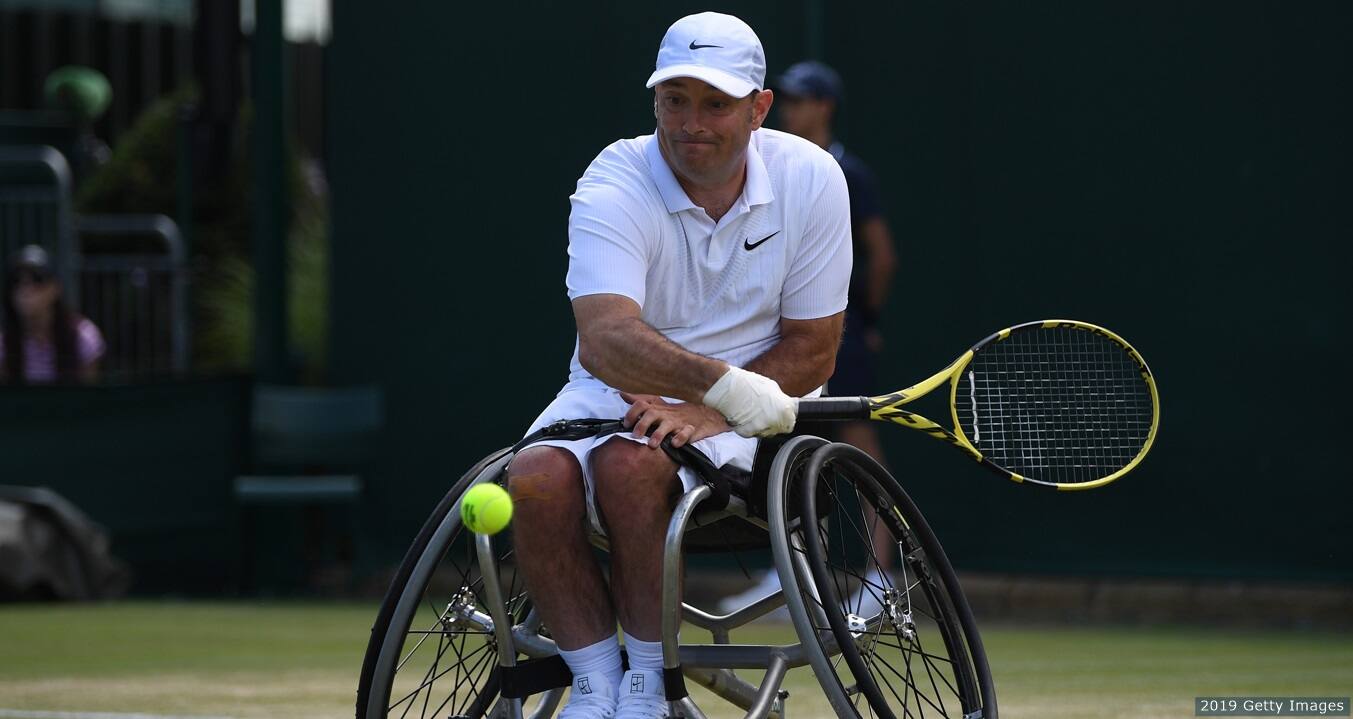
Wheelchair Tennis Preview

Wheelchair tennis, a sport created in 1976 by American Brad Parks, features both singles and doubles competitions and has grown significantly in recent years since it can be played on any regular tennis court. Wheelchair tennis is fully integrated into all four Grand Slam events, with the International Tennis Federation overseeing the sport as its governing body. Team USA is the second-most successful nation in wheelchair tennis at the Paralympic Games, trailing the Netherlands in all-time medal count.

David Wagner, a four-time Paralympian and eight-time Paralympic medalist, has been one of the top names in the sport for close to 20 years and will return for a fifth Games. Competing in both quad singles and doubles, Wagner has earned a medal in both events at each of the four Paralympic Games he has participated in. 

Wagner will again be one to watch at this summer’s Paralympic Games in Tokyo, along with returning Paralympians Shelby Baron, Bryan Barten, Emmy Kaiser and Dana Mathewson. Casey Ratzlaff and Conner Stroud will make their Paralympics debuts in Tokyo at the Ariake Tennis Park. Both athletes are three-time consecutive Jr. World Team Cup Champions. 

The rules of wheelchair tennis have one major rule deviation from able-bodied tennis. The ball is allowed to bounce twice, and just the first bounce needs to land in bounds. The Paralympic program consists of men’s and women’s singles, quad singles, men’s and women’s doubles and quad doubles. Players who compete in quads have impairments that affect three or more limbs.

Updated on July 19, 2021. For more information, contact the sport press officer.

If David Wagner is to go for a fifth consecutive medal in quad doubles, he’ll have to do it with a different partner. Nick Taylor, his doubles partner for the past four Games, will miss his first Games since 2000. 

Can anyone beat the Dutch women? The Netherlands has had both participants in every women’s singles gold-medal match in Paralympic history, and has won every gold-medal match in women’s doubles.
Bryan Barten, 47, didn’t pick up a tennis racket in his life until after being injured in a car accident in 1995. He committed to tennis and narrowly missed out on the 2008 Beijing Games. He nearly retired but came back to make the 2012 London team and the 2016 Rio team. He won a breakthrough first international medal at the 2019 Parapan American Games.

Emmy Kaiser, 31, will be making her third trip to the Games and is seeking her first medal. Her best performance to date came in Rio, when she made the Round of 16 in singles and the quarterfinals in doubles. At the 2019 Parapan American Games, she took home gold in women’s doubles with Dana Mathewson after beating the Colombian team. The San Diego native also bested her doubles partner to win the bronze in singles.

Dana Mathewson, 30, will return to the Paralympic Games for a second time looking put her name in the conversation amongst the of top female wheelchair athletes in the world. The top-ranked American in women’s singles, Mathewson took home a team-best two medals at the 2019 Parapan American Games. She advanced to the Round of 16 in singles and the quarterfinals in doubles in Rio.

David Wagner, 47, has been one of the top-ranked quads players in the world for years and currently ranks fifth in quad singles and No. 1 in quad doubles. He has medaled in both doubles and singles at all four Paralympic Games he has entered, and only in Rio did he fail to win at least one gold medal. 
August 27, 2021: Paralympic competition begins with action in men’s and women’s singles and quad doubles
August 28, 2021: Competition begins in men’s and women’s doubles and quad singles
September 1, 2021: Bronze- and gold-medal matches in quad doubles
September 2, 2021: Bronze-medal matches in men’s doubles and men’s, women’s and quad singles, gold-medal match in quad singles
September 3, 2021: Gold-medal matches in men’s doubles and women’s singles
September 4, 2021: Gold-medal matches in men’s singles and women’s doubles