
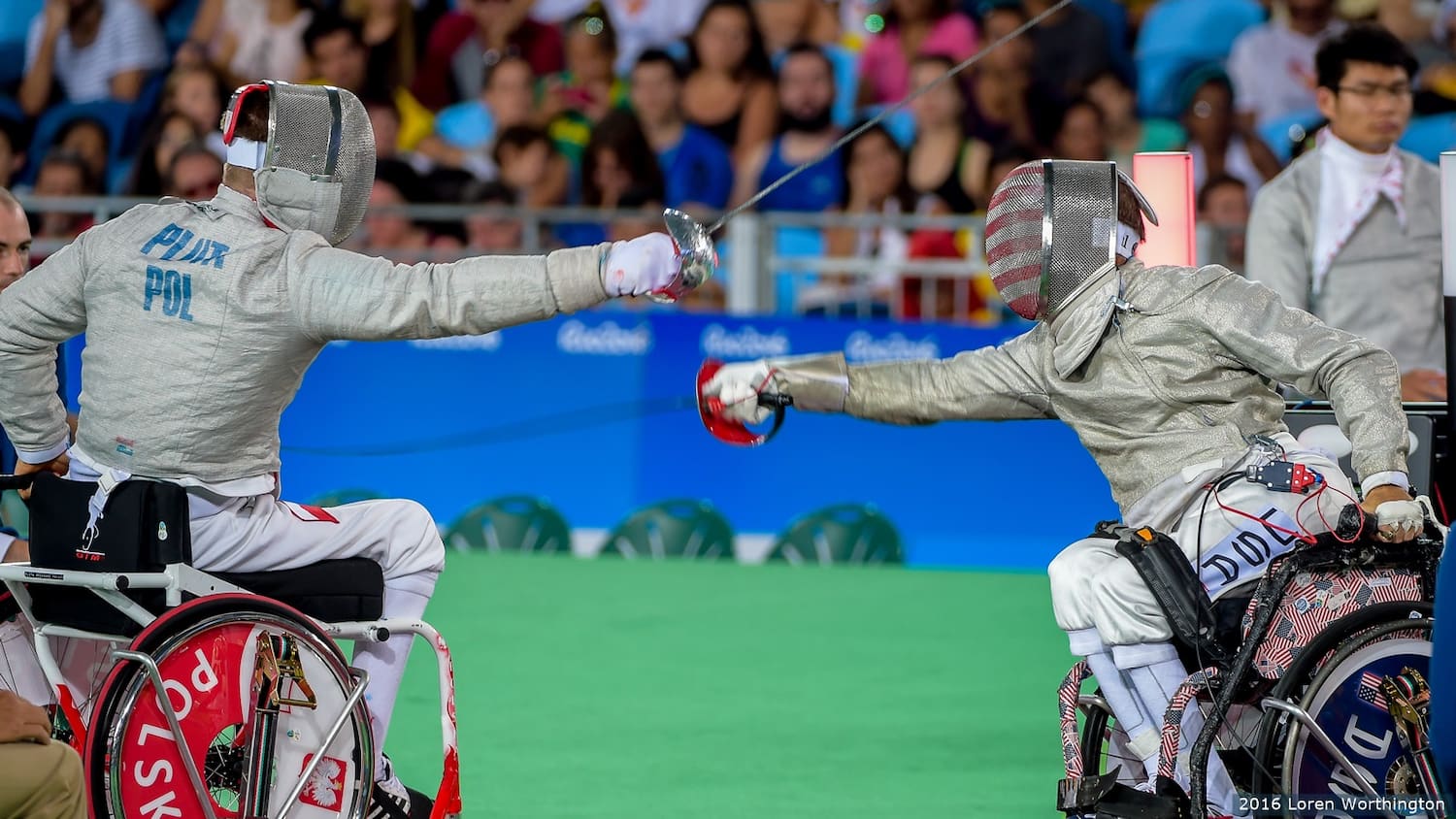
Wheelchair Fencing Preview

Team USA will send its largest contingent of athletes in wheelchair fencing since 2012 to this summer’s Paralympic Games in Tokyo in pursuit of its first gold medal. The three women headed to Tokyo also represent the first time that the U.S. has sent a full women’s team since 2004. Ellen Geddes, Terry Hayes and Shelby Jensen will all be heading to their first Paralympic Games.

Qualification for wheelchair fencing was done by individual athlete name and based on an athlete’s Combined Paralympic Ranking with the top-ranked fencer in each region qualifying for the Tokyo Games. In wheelchair fencing, North America, South America and Africa are combined into a single zone. In order to qualify by region, all individuals must be ranked among the top 25. Geddes and Jensen both were the top-ranked fencer from the Americas/Africa region. Hayes ranked second, but qualified by virtue of the top-ranked fencer changing disciplines.

As in Olympic fencing, wheelchair fencing consists of three disciplines. The epee is a heavy dueling weapon with the target covering the entire upper half of the body. The foil is a lighter weapon with the target area being the torso. And the saber is primarily a cutting weapon where the edge is used to make most hits, anywhere in the upper half of the body. Paralympic competition consists of individual events in all three disciplines and team events in epee and foil.

For wheelchair fencing, chairs are locked into place during a bout. Competitors wear the same sort of safety equipment as Olympic fencers. The same electronic scoring system is also used. Athletes compete in either Category A or B depending on their functional ability.

Updated on July 20, 2021. For more information, contact the sport press officer.

Men’s saber has been on the Paralympic program ever since the sport’s debut at the very first Paralympic Games in 1960. Sixty-one years on, women’s saber will be on the Paralympic program for the first time in 2020.

Ellen Geddes and Terry Hayes both compete in Category B, the first Team USA women to do so at the Games since Andrea Demello did in 2008.
A four-time Wheelchair World Team member and the 2018 bronze medalist in women’s epee at the America’s Championships, Ellen Geddes ranked No. 8 in the Combined Paralympic Ranking as a Category B fencer and is ranked No. 15 in the world in foil and No. 18 in epee. During the 2018-19 season, she earned three top-eight finishes, including one in both epee and foil at the world cup in Kyoto, Japan, in December 2018. The 33-year-old also earned a career-best ninth-place finish at the 2019 world championships in epee and placed 10th in foil.

Terry Hayes will be making her Paralympic debut at the age of 63. Ranked No. 33 in epee, No. 26 in foil and No. 24 in saber, Hayes earned top-32 finishes throughout the qualifying period that began in November 2018. She also scored top-32 finishes in all three weapons at the 2019 world championships.

One of Team USA’s youngest wheelchair fencers, 19-year-old Shelby Jensen won silver and bronze in Category A saber and foil, respectively, at the 2018 America’s Championships. Jensen is ranked among the top 25 in the rankings with her highest position being No. 18 in saber. She earned top-32 finishes at the 2019 world championships, the first of her young career. Jensen also now has top-16 finishes on the world cup circuit in all three disciplines.
August 25, 2021: Paralympic competition begins with men’s and women’s saber
August 26, 2021: Men’s and women’s individual epee
August 27, 2021: Men’s and women’s team epee
August 28, 2021: Men’s and women’s individual foil
August 29, 2021: Men’s and women’s foil team