

I have been a professional bike fitter and student of biomechanics for over 15 years, yet I am still surprised when I hear a rider who is unhappy with his or her saddle say, “No saddle is comfortable.”
Nothing could be further from the truth. Assuming an individual has a proper fit and their pelvis is properly rotated, there is a saddle that will be comfortable — probably several saddles. There are two main components of a saddle that determine the comfort: the shape and the rail. By understanding these, you can come to view saddles in categories, rather than as an overwhelming number of options.
Shape
The shape of the saddle is the major determinant of whether a saddle is going to work with one’s body biomechanically. There are four general saddle shapes, and once a person finds which shape works for them it becomes easy to find other saddles that may be comfortable.
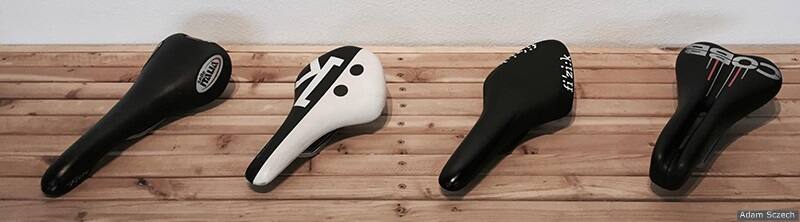
Shape 1: The Original “Saddle” Shape (I call it the saddle shape because it is the mathematical definition of a saddle i.e. z=x²-y²). This shape is characterized by a dip in the middle when looking at the saddle from the side and a rounded profile when looking at the saddle from the front/back. A few examples of this shape are the Selle Italia Flite, Selle San Marco Concor, Fizik Aliante, Prologo Scratch and the Specialized Romin. In my experience, this shape tends to be the least popular for an aero fit due to the fact there is not much room to move around.
Shape 2: The Flat-Flat Saddle. This is a pretty straight forward shape in that the saddle is flat from front to back and side to side. A few examples are the Selle Italia SLR, Fizik Antares, Cobb Fifty-Five, Prologo Zero and ISM PN 1.1.
Shape 3: The Flat-Rounded Saddle. This saddle is flat when looking at it from the side and is rounded when looking at it from the front or back. Some examples are the Fizik Arione, Fizik Volta, Prologo Kappa and Cobb Randee.
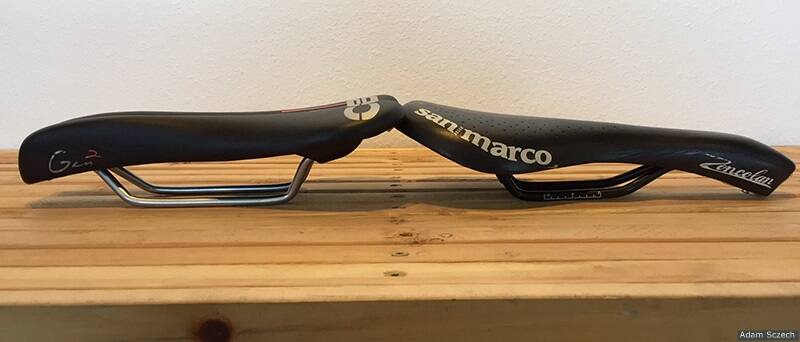
Shape 4: The Dipping-Flat Saddle. This saddle has a dip in the center when looking at it from the side and is flat when looking at it for the front or back. A few examples are the Cobb V-Flow, Cobb G2, ISM PS 1.0 and WTB Rocket.
Rail
The rail of the saddle is also a determinant of comfort but one of the most overlooked. While rails come in several different materials (steel, titanium and carbon), the length of the rail is what tends to be the most important. While the length of the rail is important for fitting purposes, it is also directed related to the amount the saddle is able to move in relation to the bike. The rail acts like a shock absorber. The longer the rail, the more shock absorption which allows for a more comfortable saddle.
Other Things To Consider
As a fitter, I have discovered that there are other aspects of the saddle that influence comfort.
Cutouts: Cutouts may provide perineal relief, but is important to remember that a narrow saddle with a large cutout will have very little surface area for actual sitting causing more discomfort.
Padding: The softer a saddle is, the less comfortable it will be for long rides. It is a little counterintuitive, but the softer and deeper the padding, the more the sit bones can sink into the saddle. This causes the padding to press more against the soft tissue and can ultimately lead to numbness.
So, if you are unhappy with your current saddle or simply want to try some new options, seek out different saddle shapes and see which one works the best for you.
Adam Sczech coaches for Team MPI and is a USA Triathlon Level I Certified Coach, IRONMAN Certified Coach and a certified bike fitter based out of the Western Slope of Colorado. He can be reached at adam@teammpi.com.
The views expressed in this article are the opinion of the author and not necessarily the practices of USA Triathlon. Before starting any new diet or exercise program, you should check with your physician and/or coach.